 PT
 EN
 FR
 ES
 JA
 KO
 ZH
 AR
 FA
 RU
 NL
 MS
 VI
 PH
 TH
 ID



The Darvas Box Theory is a breakout trading method that uses price consolidation ranges to identify potential opportunities for trend continuation. Developed by Nicolas Darvas, a ballroom dancer who turned $36,000 into more than $2 million through stock trading in the late 1950s, the strategy remains a recognised approach to análise técnica.
What Is the Darvas Box?
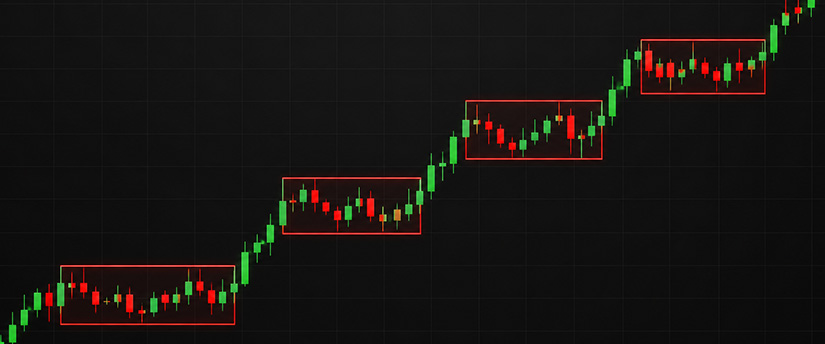
It is a breakout trading method that focuses on price consolidation. The idea is simple: when a stock or other instrument pauses within a relatively tight range after a strong upward move, it may be forming a box. Traders use that range to identify potential breakout opportunities.
Here’s how it works:
- Top of the box: The recent high that the price has struggled to move above.
- Bottom of the box: The lowest point the price reaches during the consolidation.
- Breakout: When the price moves above the top of the box, it may signal the start of another upward move.
A breakout above the upper boundary may indicate renewed buying pressure, while a move below the lower boundary can signal that the consolidation structure has failed.
How Nicolas Darvas Drew His Boxes
Darvas documented his approach in Chapter 4, Developing the Box Theory, of his book, How I Made $2,000,000 in the Stock Market. He didn’t rely on trading software to identify his boxes. He marked them by hand and followed a strict set of rules. A new high only counted once the price had gone three consecutive days without reaching a higher level. At that point, he could mark the top of the box. He used a similar process to identify the bottom.
The box only takes shape once the market has established clear boundaries.
Darvas looked for an entry when the price broke above the confirmed top of the box with strong upward momentum. He then placed a stop-loss just below the bottom of the box. This gave him a defined exit level if the trade moved against him, although it couldn’t guarantee a loss would be limited to that exact level.
Advantages and limitations of the Darvas Box
| Advantages | Limitations |
| Provides clearly defined support and resistance boundaries. | False breakouts can trigger unsuccessful trades. |
| Offers a structured approach to breakout entries. | Performs less reliably in sideways markets. |
| Helps traders identify potential trend continuation. | Requires patience while the box develops. |
| Includes a logical reference point for stop-loss placement. | Gaps and slippage can increase actual losses. |
Applying the Strategy across Modern Markets

Originally developed for stock trading, the Darvas Box can also be used in forex, indices and commodities, provided the instruments have sufficient liquidity and clear price movements.
On MetaTrader 4 and MetaTrader 5, traders can draw horizontal lines to mark the upper and lower boundaries or use an indicator available on the platform.
Step-by-Step: How to Build a Darvas Box
| Step | What to do | What to look for |
| 1. Identify an uptrend | Find an instrument showing strong upward momentum. | Recent highs and sustained buying pressure. |
| 2. Wait for consolidation | Allow the price to move within a defined range. | No new highs for at least three consecutive sessions. |
| 3. Set the upper boundary | Mark the confirmed high. | The highest price reached before consolidation. |
| 4. Set the lower boundary | Identify the lowest price within the range. | A clearly defined consolidation low. |
| 5. Confirm the breakout | Wait for the price to close above the upper boundary. | A move beyond the established resistance level. |
| 6. Manage the trade | Define the stop-loss and exit strategy. | Stop below the box and monitor subsequent price action. |
Before entering a trade, consider the potential risk and define your exit conditions. A breakout above the box does not guarantee that the upward trend will continue.

Common Mistakes to Avoid
Prematurely identifying a box can result in inaccurate boundaries and false breakout signals. Follow the three-session confirmation rule before establishing the upper boundary to avoid reacting to short-term price fluctuations.
Another mistake is overlooking volume. The Darvas Box was developed in the stock market, where traded volume data was available. In forex, retail trading platforms typically show tick volume, which measures price updates rather than the actual number of units traded. It can provide useful clues about market activity, but should be treated as supporting information rather than definitive breakout confirmation.
False breakouts are another challenge. The price may move above the box, trigger an entry, and then quickly fall back into the range. A stop-loss below the box bottom can help define trade risk, although slippage and gaps may affect the final exit price. Risk management should always be part of the trading plan.
Using the Darvas Box as Part of a Broader Strategy
No trading method works equally well in all market conditions. Breakout strategies tend to perform better in trending markets, while choppy, sideways conditions can produce more false signals.
Traders can use a long-term moving average to assess the broader market trend. If an instrument trades above its moving average, this may provide additional confirmation of upward momentum.
A conta demo is a useful starting point for testing trading strategies, refining trading rules and building confidence without risking real money.
FAQs
What is the Darvas Box Theory?
A breakout trading strategy that uses price consolidation ranges to identify potential trend continuation opportunities.
How do you identify a Darvas Box?
Look for a price range where no new high is reached for three consecutive days. Mark the upper and lower boundaries of the consolidation.
Can the Darvas Box be used in forex trading?
Yes. Although developed for stocks, the strategy can also be applied to forex, indices and commodities.
Which indicator works best with the Darvas Box?
A moving average can help confirm the broader trend and filter potential breakout signals.
DISCLAIMER: This content is for general informational and educational purposes only and should not be considered investment advice or investment recommendation.

